



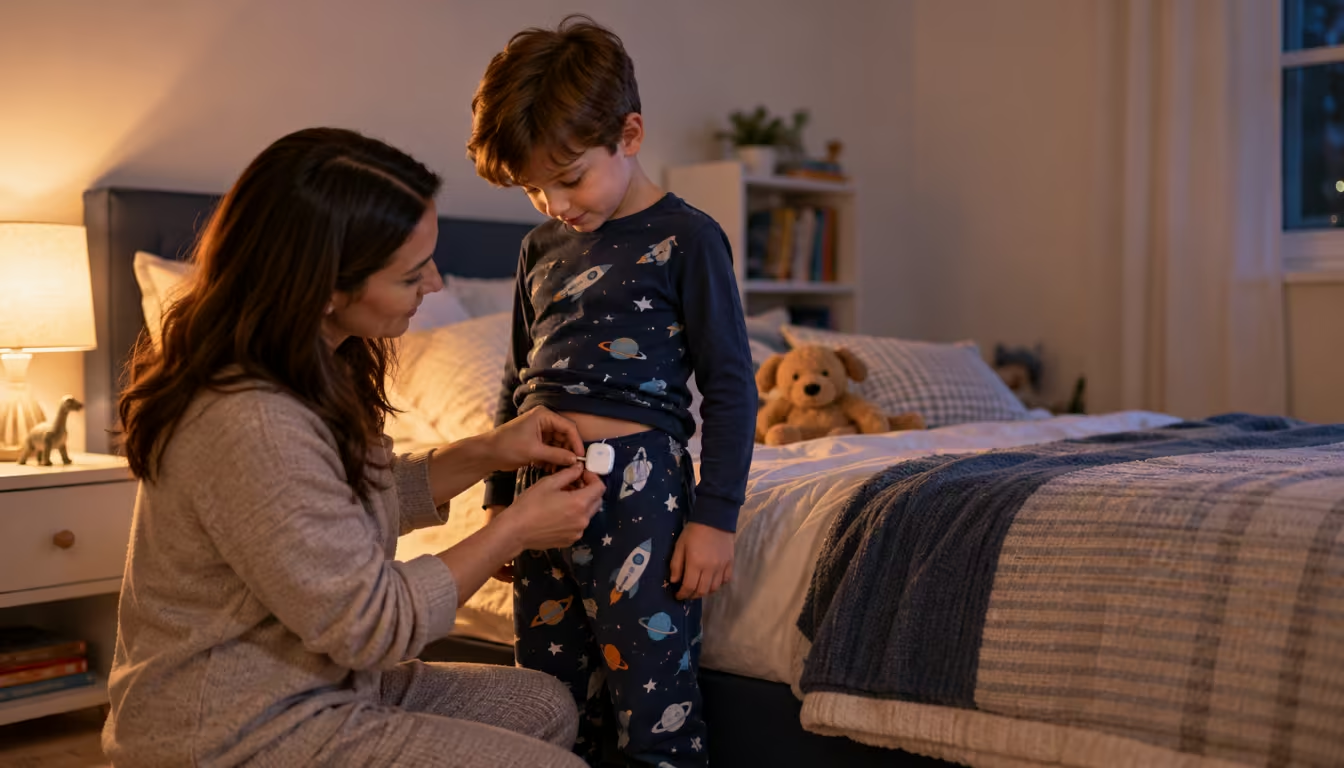
How Long Does a Bedwetting Alarm Take to Work? What Parents Should Expect
Overview
A bedwetting alarm usually does not produce completely dry nights immediately. Bedwetting alarm training is a learning process in which the sleeper gradually begins recognizing bladder signals, responding to the alarm, waking more quickly, and eventually getting to the bathroom before significant wetting occurs.
Some children begin showing signs of progress relatively quickly, while others need considerably more time. Sleep depth, age, consistency, moisture detection, alarm strength, parental involvement, and how correctly the alarm is used can all influence the process.
The most important point for parents is that progress should not be measured only by whether the bed is completely dry. Smaller wet spots, waking sooner, responding independently to the alarm, and getting to the bathroom earlier can all be signs that bedwetting alarm training is beginning to work.
This guide explains what parents can reasonably expect, how to recognize progress, why some children take longer than others, and what to check when a bedwetting alarm does not appear to be working.
Introduction
Parents often ask one question shortly after starting alarm training:
How long does a bedwetting alarm take to work?
There is no single answer that applies to every child.
A bedwetting alarm is not designed simply to make a loud noise when the bed becomes wet. Its purpose is to detect moisture early and create a repeated association between bladder activity, waking, and going to the bathroom.
That association develops over time.
During the first nights, a child may sleep through the alarm completely. Later, the child may begin waking only after a parent helps. Eventually, the sleeper may respond to the alarm independently or even begin waking before the alarm activates.
Families therefore need to look at the entire pattern of progress rather than expecting an immediate transition from regular wet nights to completely dry nights.
The right alarm can also make a difference. Families comparing different bedwetting alarms should consider moisture detection, alarm strength, vibration, comfort, reliability, and whether the system suits the sleeper’s nighttime habits.
Table of Contents
- How Quickly Can a Bedwetting Alarm Start Working?
- What Progress Looks Like During the First Stage
- Why Some Children Take Longer Than Others
- How Deep Sleep Affects Bedwetting Alarm Training
- Why Consistency Matters
- How Moisture Detection Affects Results
- The Role of Parents During Alarm Training
- Signs That a Bedwetting Alarm Is Working
- What If There Is No Improvement?
- When Should You Consider a Different Alarm?
- How Long Should You Continue Using the Alarm?
- Frequently Asked Questions
- Final Thoughts
1. How Quickly Can a Bedwetting Alarm Start Working?
The first signs that a bedwetting alarm is working may appear before consistently dry nights.
Parents sometimes expect success to mean that the child immediately stops wetting the bed. In reality, progress often happens in stages.
At first, the alarm may activate after wetting begins and the child may remain asleep.
Later, the child may begin to:
- Wake when the alarm sounds
- Wake with parental assistance
- Produce a smaller wet patch
- Stop urinating after the alarm activates
- Finish urinating in the bathroom
- Wake before a full bedwetting event
- Begin having more dry nights
These intermediate changes matter.
They suggest that the child is becoming more responsive to the alarm and nighttime bladder signals.
For that reason, parents should avoid judging an alarm after only a few nights.
2. What Progress Looks Like During the First Stage
The beginning of alarm training can be the most frustrating period for families.
The alarm may sound repeatedly, the child may not wake independently, and laundry may still be necessary.
That does not automatically mean the alarm is failing.
During the early stage, the goal is to establish a consistent nighttime pattern:
moisture → alarm → waking → bathroom → reset → return to sleep
Repeating that pattern is important.
Parents should look for small changes such as faster waking, reduced wetting, or improved awareness when the alarm activates.
A progress chart can be helpful.
Instead of recording only “wet” or “dry,” parents can track:
- Whether the alarm activated
- Whether the child woke independently
- Whether a parent needed to help
- How much wetting occurred
- Whether the child finished in the bathroom
- Whether the alarm needed repositioning or adjustment
This gives a much clearer picture than simply counting dry nights.
3. Why Some Children Take Longer Than Others
Two children using the same alarm can have very different experiences.
Several factors may influence how quickly a sleeper responds.
Sleep Depth
A very deep sleeper may initially require stronger alerts and greater parental involvement.
Age
Older children may understand the process more easily, while younger children may require more help with setup and nighttime response.
Alarm Consistency
Using the alarm every night provides repeated opportunities for learning.
Sensor Placement
A poorly positioned moisture sensor may activate later than intended.
Comfort
If the alarm is uncomfortable, the child may resist wearing or using it consistently.
Alert Type
Some sleepers respond well to sound. Others may benefit from vibration, light, or multiple changing tones.
Family Routine
A clear, calm response each time the alarm activates can make the training process easier to maintain.
The important point is that slower progress does not automatically mean the child or the alarm has failed.
4. How Deep Sleep Affects Bedwetting Alarm Training
Deep sleepers are one of the most common reasons parents become concerned that an alarm is not working.
A child may continue sleeping even when an alarm sounds close to the body.
In this situation, alert variety becomes particularly important.
A system that combines several alert methods can provide more stimulation than a simple single-tone alarm.
For example, the Chummie Premium bedwetting alarm combines multiple selectable sounds with vibration and visual alerts.
However, even a strong alarm may not cause a deep sleeper to wake independently during the first stage of training.
Parents may need to help.
When the alarm activates, the parent can wake the child sufficiently to recognize what is happening, use the bathroom, and reset the system.
Over time, the goal is for the sleeper to assume more of this responsibility independently.
5. Why Consistency Matters
A bedwetting alarm should not be treated like something used only on convenient nights.
Consistency matters because alarm training depends on repetition.
If the alarm is used for three nights, skipped for two nights, restarted for one night, and then abandoned for a week, the process becomes much less consistent.
A better approach is to incorporate the system into the normal bedtime routine.
Before sleep:
- Set up the alarm.
- Position the sensor correctly.
- Confirm that the alarm is connected.
- Test it if appropriate.
- Make sure the child understands what to do when it activates.
After an alarm:
- Wake the child fully enough to respond.
- Go to the bathroom.
- Finish urinating.
- Change wet clothing if needed.
- Reset the alarm.
- Return to bed.
The routine should remain calm and predictable.
6. How Moisture Detection Affects Results
A bedwetting alarm cannot respond until moisture reaches the sensor.
This makes moisture detection one of the most important parts of the system.
With wearable alarms, the sensor should be positioned according to the manufacturer’s directions and close to where the first moisture is likely to occur.
If the sensor is placed too far away, the alarm may not activate until more wetting has occurred.
Bedside systems work differently because they detect moisture on a sensing mat rather than through a sensor attached to clothing.
Neither style is automatically best for everyone.
Families who want to understand the differences can compare bedwetting alarms based on sensor type, alert features, comfort, and intended user.
7. The Role of Parents During Alarm Training
Parents can play an important role, particularly at the beginning.
If the child sleeps through the alarm, simply turning it off while the child remains asleep does little to reinforce the desired nighttime response.
Instead, the parent should help the child wake and participate in the routine.
The amount of assistance can gradually decrease as the child becomes more responsive.
This progression might look like:
Stage 1: Parent wakes the child when the alarm activates.
Stage 2: Child begins waking more easily with minimal parental help.
Stage 3: Child responds independently to the alarm.
Stage 4: Child begins waking before significant wetting occurs.
Stage 5: Dry nights become increasingly common.
Not every child follows this exact sequence, but it illustrates why parental involvement should generally decrease as independence increases.
8. Signs That a Bedwetting Alarm Is Working
Parents should look for more than dry nights.
Several changes can indicate progress.
Smaller Wet Spots
The sleeper may begin stopping urination sooner after the alarm activates.
Faster Response
The child may wake more quickly than during the first few nights.
Less Parental Assistance
A child who originally needed to be fully awakened may start responding independently.
Bathroom Completion
The child begins finishing urination in the bathroom rather than completely emptying the bladder in bed.
Waking Before the Alarm
This can be an important sign that bladder awareness is improving.
More Dry Nights
Eventually, dry nights may become more frequent.
These gradual changes are often more useful for evaluating progress than expecting an immediate cure.
9. What If There Is No Improvement?
If there appears to be no progress, check the basic setup before assuming that alarm training has failed.
Ask:
Is the alarm being used every night?
Inconsistent use can make progress harder to evaluate.
Is the sensor positioned correctly?
Poor sensor placement can delay activation.
Does the alarm activate reliably?
Test the alarm and inspect the sensor, wires, batteries, or power source.
Does the child actually wake?
If not, parental assistance or a stronger alert system may be needed.
Is the alarm comfortable?
An uncomfortable system may be difficult to use consistently.
Is the child completing the nighttime routine?
Turning off the alarm and immediately returning to sleep is different from waking, going to the bathroom, resetting the alarm, and returning to bed.
If the current alarm repeatedly creates practical problems, families can review bedwetting alarm reviews to understand how other designs and features compare.
10. When Should You Consider a Different Alarm?
Changing alarms should not be the first response to slow progress.
However, another system may make sense when the current alarm clearly does not fit the sleeper.
Consider a different alarm if:
- The child consistently sleeps through the available alerts
- The moisture sensor repeatedly detaches
- The sensor has become unreliable
- The sleeper finds the alarm uncomfortable
- Wires interfere significantly with sleep
- The system is difficult to reset
- The alarm is damaged
- The child strongly prefers a bedside rather than wearable design
- The sleeper’s needs have changed with age
The goal is not to continually switch products.
It is to identify whether there is a genuine mismatch between the alarm and the sleeper.
11. How Long Should You Continue Using the Alarm?
Parents should focus on sustained progress rather than a fixed number of nights.
Stopping immediately after one or two dry nights may be premature.
Likewise, continuing indefinitely without reviewing what is happening may not be useful.
Look at the pattern:
- Are wet nights becoming less frequent?
- Is the wet area becoming smaller?
- Is the child waking more quickly?
- Is parental assistance decreasing?
- Is the child beginning to wake before the alarm?
If progress is occurring, consistency may be more important than changing the system.
If no meaningful improvement is occurring despite proper setup and regular use, review the process and consider whether another alarm style would better match the sleeper.
For broader information about nighttime wetting and treatment approaches, families can also review additional bedwetting guidance.
Frequently Asked Questions
How long does a bedwetting alarm take to work?
There is no exact timeline that applies to every child. Some sleepers show signs of progress sooner than others. Parents should look for gradual changes such as faster waking, smaller wet spots, more independent alarm response, and increasing numbers of dry nights.
What if my child does not wake to the bedwetting alarm?
This is common with deep sleepers. Parents may need to help wake the child initially. An alarm with multiple tones, vibration, or visual alerts may also provide additional stimulation.
Does sleeping through the alarm mean it is not working?
Not necessarily. The alarm may be detecting moisture correctly even if the child does not yet wake independently. Parental assistance may be needed during the early stages.
How do I know if bedwetting alarm training is improving?
Signs of improvement include smaller wet areas, faster waking, finishing urination in the bathroom, less parental help, waking before the alarm, and more frequent dry nights.
Should a bedwetting alarm be used every night?
Consistency is important. Regular nighttime use creates repeated opportunities for the sleeper to associate bladder activity with waking and going to the bathroom.
Should I buy a stronger alarm for a deep sleeper?
Possibly. If the sleeper repeatedly fails to respond, an alarm offering several forms of alert—such as changing sounds, vibration, and lights—may be worth considering.
Is a bedside alarm better than a wearable alarm?
Neither style is universally better. Wearable systems place the sensor close to the point of moisture, while bedside systems eliminate the need to attach a sensor to clothing. The best choice depends on comfort, sleep habits, age, and preference.
When should I stop using a bedwetting alarm?
Rather than stopping after one successful night, look for sustained improvement. If progress is unclear or bedwetting persists despite consistent and correct use, consider reviewing the routine and discussing ongoing concerns with an appropriate healthcare professional.
Final Thoughts
A bedwetting alarm usually works through repetition and learning rather than producing an immediate change after the first few nights.
Parents should therefore look for gradual progress.
Waking sooner, reducing the amount of wetting, responding more independently to the alarm, and getting to the bathroom earlier can all indicate that the training process is moving in the right direction.
Consistency, correct sensor placement, suitable alert strength, comfort, and parental support can all influence how smoothly alarm training progresses.
Families beginning the process can learn more about the Chummie bedwetting alarm or compare the complete range of Chummie bedwetting alarms to find a system that fits the sleeper’s needs.
Related Articles
Why Bedwetting Alarms Fail: 9 Mistakes That Can Delay Dry Nights
How to Choose the Best Bedwetting Alarm for Your Child: The Complete Parent’s Guide
No Comments